
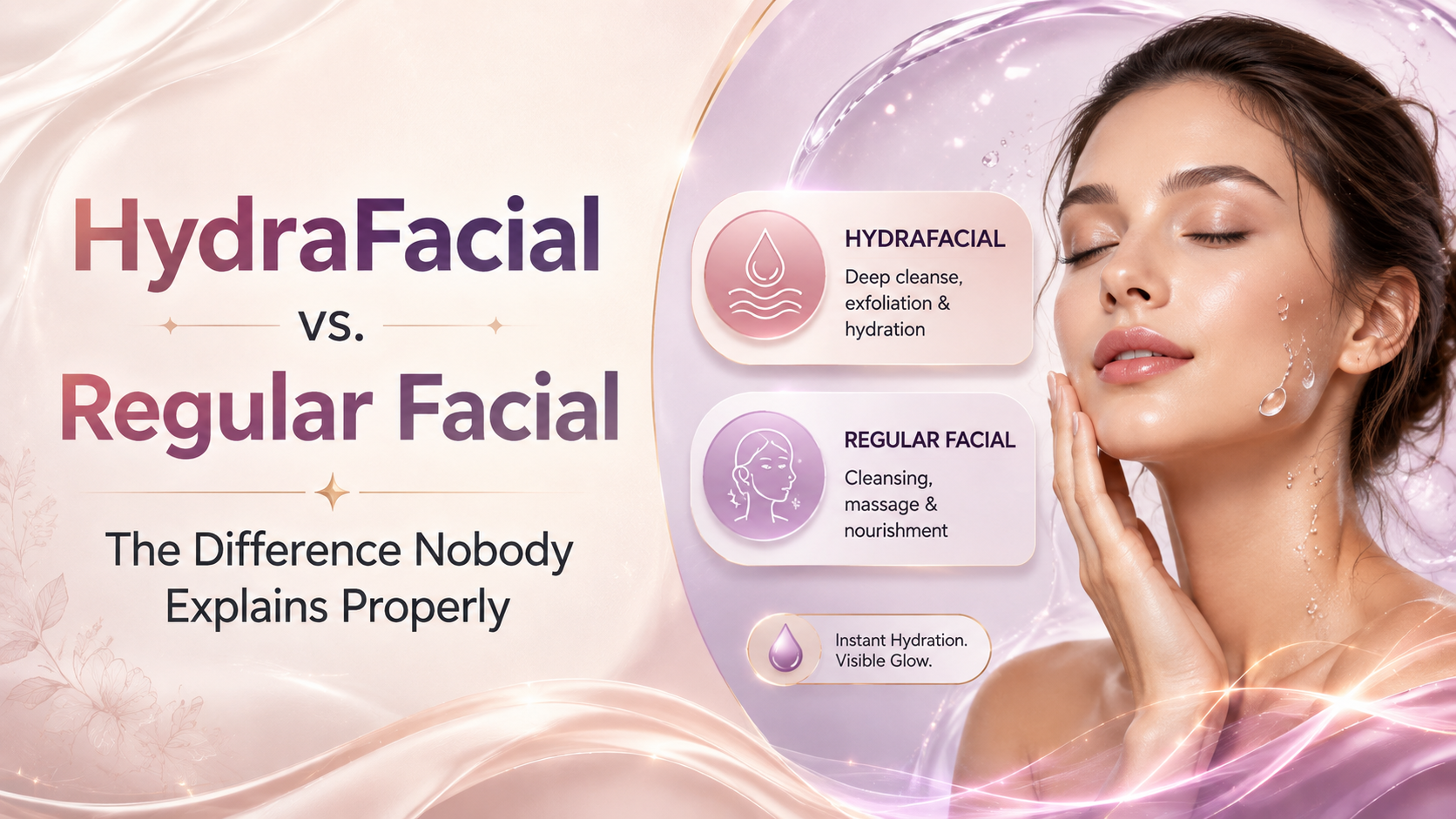
You book a facial because your skin looks dull, congested, dry, or tired. Then the menu gives you two choices that sound almost interchangeable: a regular facial and a HydraFacial.
Both promise cleaner, fresher, glowing skin. Both involve cleansing and hydration. So why does a HydraFacial usually cost more, and when is it actually the better choice?
The real difference is not that one is “good” and the other is “basic.” It is how the skin is treated, how extractions are performed, and how hydration is delivered. Once you understand that, choosing the right facial becomes much easier.
At N Salon, the right facial should begin with your skin, not with a trend. Here is the comparison most people wish they had before booked.
What Is a Regular Facial?
A regular facial is a broad category rather than one fixed treatment. Depending on the facial selected, it may include cleansing, exfoliation, steam, manual extraction, massage, a mask, toner, moisturizer, and finishing products.
Its biggest strength is flexibility. A professional can choose products for dryness, oiliness, dullness, sensitivity, or general maintenance.
Results can vary because they depend on the products used, the professional’s technique, and the amount of manual exfoliation or extraction involved.
In simple terms, a regular facial is primarily product-led and hands-on.
What Is a HydraFacial?
A HydraFacial is a device-based, non-invasive treatment that combines several skincare steps in one structured session. The system cleanses and exfoliates, removes impurities with controlled suction, and delivers hydrating serums onto the skin.
Instead of treating exfoliation, extraction, and hydration as mostly separate manual steps, HydraFacial technology performs them through a controlled device-led process. Treatments can also be customized with boosters depending on the skin concern.
The simplest explanation: a HydraFacial is more technology-led, standardized, and treatment-focused.
HydraFacial vs. Regular Facial: The Core Differences
1. Exfoliation
In a regular facial, exfoliation may come from a scrub, enzyme, mild acid-based product, or another salon formulation. The intensity depends on the treatment.
A HydraFacial uses specialized tips and solutions in a controlled resurfacing process. It removes dead surface cells without relying on aggressive physical scrubbing.
For smoother-looking texture and a more consistent process, HydraFacial may have an advantage. For maintenance, a regular facial may be enough.
2. Extraction
This is often the biggest practical difference.
Regular facials commonly use manual extraction after steam or skin preparation. Done properly, this can clear visible blackheads and congestion, but it may feel uncomfortable and can leave temporary redness.
HydraFacial uses controlled suction to lift impurities from the pores. Many clients prefer this because the process can feel gentler and more uniform than manual squeezing.
3. Hydration
A regular facial restores moisture through serums, masks, creams, and massage products. The hydration benefit depends largely on the products selected.
HydraFacial is specifically designed to pair cleansing and extraction with serum infusion. That is one reason skin can look plumper, smoother, and more luminous immediately after treatment.
4. Relaxation vs. Treatment Focus
A regular facial usually wins on classic spa-style relaxation. Massage, masks, and slower manual steps make it feel like a pampering ritual as well as skincare.
A HydraFacial can still be comfortable, but the experience is more procedural. The focus is on moving efficiently through cleansing, exfoliation, extraction, and hydration.
Ask yourself what you want most: relaxation and maintenance, or a technology-driven facial treatment with visible surface refinement.
5. Consistency
“Regular facial” can describe many different protocols, so results may vary from one treatment or professional to another.
A HydraFacial follows a more defined device-based process. It can still be customised, but the core steps are more standardised. That consistency can be valuable for repeat clients.
Which Facial Is Better for Your Skin Type?
There is no universal winner. The best facial depends on your current skin condition and goal.
For oily or congested skin, HydraFacial may be useful when the main concerns are clogged pores, rough texture, and excess buildup. A regular facial for oily skin can also work well for routine maintenance.
For dry or dehydrated skin, both treatments can help. HydraFacial’s hydration-focused process may provide a stronger immediate plumping effect, while a nourishing regular facial can be ideal when the skin mainly needs comfort and moisture.
For sensitive skin, professional assessment matters more than the treatment name. Products, acids, suction strength, fragrance, and massage technique may all need adjustment.
For dull or event-ready skin, HydraFacial is often chosen for a smooth, hydrated appearance with little downtime for many clients. A regular facial can also give a healthy glow.
When Is a Regular Facial the Smarter Choice?
Choose a regular facial when you want relaxation, massage, basic cleansing and hydration, periodic maintenance, or a more budget-friendly salon skincare treatment.
When May a HydraFacial Be Worth It?
Consider HydraFacial when you want a structured multi-step treatment, controlled extraction, strong hydration, visible surface refinement, or a treatment personalised around a specific concern.
It can also appeal before an occasion when you want skin to look fresh without a long recovery period.
The Bottom Line
The HydraFacial vs. regular facial debate becomes simpler once you stop comparing them only by the word “glow.”
A regular facial is flexible, hands-on, relaxing, and highly dependent on the products and technique used. A HydraFacial is device-led, more standardised, and combines cleansing, exfoliation, extraction, and hydration in a structured protocol.
The best facial is the one that matches your skin condition, comfort level, routine, and goal.
At N Salon, start with a professional consultation and choose a treatment based on what your skin actually needs. Good skincare is not about doing more. It is about doing the right thing at the right time.
Frequently Asked Questions
1. Is HydraFacial better than a regular facial?
Not automatically. HydraFacial may be better for clients seeking device-based exfoliation, controlled extraction, hydration, and consistency. A regular facial may be better for relaxation and routine maintenance.
2. Does HydraFacial hurt?
It is generally designed to be gentle and non-invasive. Most people find the suction mild, although comfort varies with skin sensitivity and treatment settings.
3. Can I get a HydraFacial before an event?
Many clients do because the treatment is designed to leave skin looking hydrated and refreshed with minimal downtime. If your skin is reactive, schedule your first session well before an important event.
4. Can sensitive skin get a HydraFacial?
Potentially, but it should be customised. Tell your skincare professional about sensitivity, irritation, allergies, recent procedures, and active skincare products beforehand.
5. Which facial is best for blackheads and clogged pores?
HydraFacial can be a strong option because controlled suction is used for extraction. Traditional facials can also address blackheads manually. The better choice depends on your congestion and sensitivity.
6. How do I choose the right facial at N Salon?
Start with your main concern: dryness, congestion, dullness, sensitivity, texture, or maintenance. A professional consultation can match your skin with the most appropriate treatment rather than choosing only by name or trend.